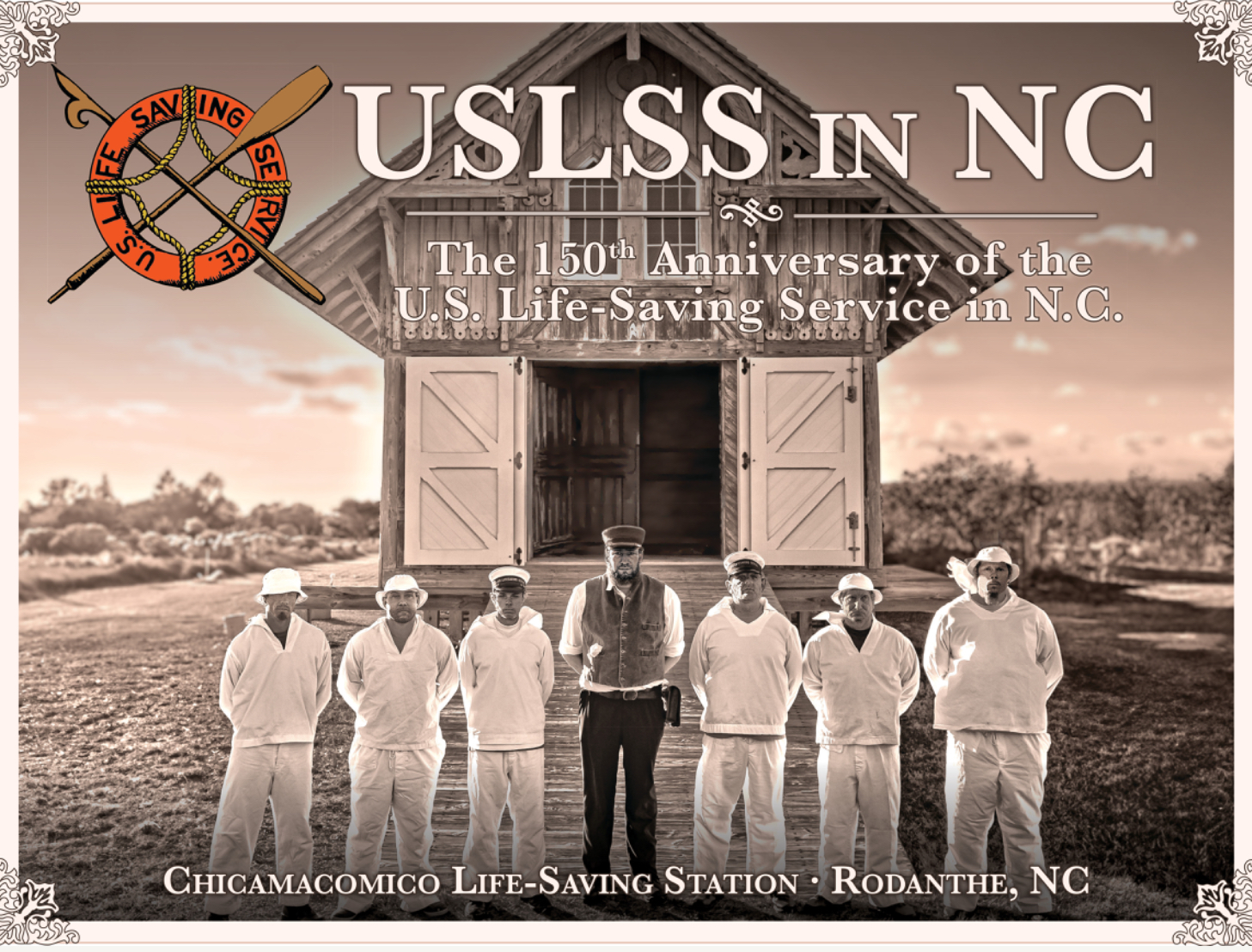
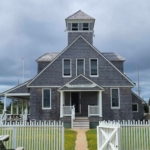
With its two stations and five outbuildings, Chicamacomico (pronounced chik a ma COM i co) is the most
complete site of remaining life-saving stations in North Carolina and one of the nation’s most complete
sites. This site is located on Hatteras Island in the village of Rodanthe on the Outer Banks of North
Carolina. Built and manned in 1874, Chicamacomico was the first United States Life-Saving Service station
in North Carolina, dedicated to the sole purpose of rescuing lives in peril from the sea. After the U.S.
Life-Saving Service evolved into the U.S. Coast Guard in 1915 this station saw service until 1954. It is
home to one of the greatest rescues in early Coast Guard history, the 1918 rescue of forty-two crew members
of the British tanker, Mirlo. The six U.S. Life Savers involved in that rescue were awarded the Gold
Life-Saving Medal from the U.S. Treasury Department. Additionally, the Officer in Charge, BMC John Allen Midgett, Jr.,
was awarded the Silver Cup from the British Trade Commission.
King George of England was so appreciative of the heroes of Chicamacomico and their valiant efforts that
he fashioned a gold medal in their honor and awarded it to these same men. The greatest honor bestowed
upon them was the Grand Cross of the American Cross of Honor. Only eleven of these medals have been awarded
in the history of the United States; six of these medals were conferred upon the rescuers of Chicamacomico
Life-Saving Station. Many other important rescues are documented in our archives. In the forty-four year
history of the U.S. Life-Saving Service, 177,286 lives were saved of the 178,741 lives in peril (99.2%),
a record unparalleled even today. Remarkably, this is coupled with a less than one percent loss of life
for the actual U.S. Life Savers. No life-savers were ever lost from Chicamacomico, mainly because of
their superb training.
Chicamacomico Life-Saving Station Historic Site is listed on the National Register of Historic Places,
and is a proud member of Historic Albemarle Tour.
Our purpose is to restore, preserve, protect, educate and interpret the rich history of these valiant men
and their dedication to the U.S. Life-Saving Service, as well as interpreting the history of the buildings
and artifacts. We are open to the public from mid-April through November, and provide our visitors with tours,
programs, reenactments and special events.

|