|
The United States Life-Saving Service
The history of the Life-Saving Service buildings begins with
the U.S. Treasury Department in 1848. During this time, the
Department realized they were paying too much to rent and lease
space for government buildings. The decision was made to build
Post Office buildings, Pony Express buildings and office
buildings which would belong to the Department. Mr. Mullet was
placed in charge and soon found that he was given a group of
political appointees and other non-architects to do the work.
Without a staff of architects, he utilized his own staff to
learn and create specific parts of buildings. He would sketch
what he wanted; the foundation person would draw the foundation,
the window person would do their part and so on. The standards
set would be used for this size building in the future. The
process would allow the building to grow using standards of
doors, windows, roof and trim. By this process about 1300 Post
Offices were built. Each year standards were changed on such
things as trim. Copies of these standards are available at the
University of Michigan.
In 1848, the Revenue Marine Division of the Revenue Cutter
Service, a division of the Treasury Department, had the
Life-Saving Service added to its responsibilities. The buildings
designed by Mullets' group were mostly boathouses. In 1869 the
first crews were employed by the U.S. Life-Saving Service for
alternate stations. These crewmen were political appointees as
well as Postal Service employees with no real training in
life-saving. Consequently, there were some tragic results
arising from this decision. Without proper training, numerous
lives were lost during rescues that might have been saved
otherwise.
North Carolina receives its first seven stations
On April 20, 1871, Congress voted an appropriation of $200,000
for Life-Saving purposes. Sumner Increase Kimball was nominated
by President Ulysses S. Grant, and without going through the
committee process was confirmed as General Superintendent of
Life-Saving Service. Of the twelve Districts formed, the Sixth
District was comprised of Virginia and North Carolina and funds
were appropriated to begin building Life-Saving Stations in the
Sixth District in 1874.
On November 15, 1871 Francis W. Chandler was added to the staff as
Assistant Architect at $8.00 per day. Chandler was a
European-trained Architect with a great understanding of classic
architecture, which was clearly reflected in his work. The 1874
station at Chicamacomico is one of his early designs.
By 1874, funds were appropriated to begin building Life-Saving
Stations in North Carolina. The first seven Stations were to be
built of wood without "much reference to architectural effect,
but designed to withstand the tempest, and afford comfortable
quarters for the surfmen and convenient rooms for the
apparatus." The design of the building is called timber frame.
This design was developed in the Northeast and found to able to
stand the worst of weather conditions. The frames were made in a
mill in New Bern, NC. On the first floor there was a boat room
and a "day room", which was the kitchen, dining room, and
recreation room all-in-one; on the second floor were found the
keeper's office, keeper's quarters, and the sleeping quarters
for the crew and shipwreck survivors. An open platform lookout
tower for the day-watch was placed upon the roof, and there was
a flagstaff for signaling. A drill pole was erected for the
purpose of practicing rescue techniques with the
beach-apparatus. The station’s equipment was usually comprised
of two boats with outfits, a life-car, two sets of
breeches-buoys, a mortar and cart, cork life jackets,
heaving-sticks, Coston signal flares, rockets, signal flags,
barometer, thermometer, and necessary furniture.
Superintendents were to be a resident of the District, of good
character, not less than 25 or more than 55 years old when
appointed. The first crews were comprised of six surfmen. They
were to cover the "worst three months of the year". The keeper
was hired for the full year.
The first ten stations in District Six were built with three in
Virginia and seven in North Carolina. James H. Boyle, a Northern
contractor who had recently relocated to New Bern, NC, bid
$2,375.00 for each house. When a compliance bond of $30,000.00
was required Mr. Boyle was not able to secure bondsmen. He in
turn proposed the government retain $400.00 per house until
completed. His main problem was that the “moneyed people” of New
Bern had no use for people such as he, who had moved South after
Federal troops had occupied the area.
When Boyle found the inter-coastal schooners avoided the Outer
Banks during winter months his schedule was upset. Without the
schooners able to deliver lumber and supplies, his promise of
completing a station “one a month starting in September” was not
to be. Secretary Richardson sanctioned concessions provided he
completed three buildings by December 1, 1873. If he did not, he
was to pay $25.00 per house per day. This was accepted August
23, 1873. On September 23, Lieutenant Lewis M. Stodder found
Boyle "was putting up the frames of stations regardless of the
proper sites or dimensions of houses, not having proper plans to
work by."
Stodder requested permission to charter a vessel to carry him to
Hatteras Island. There was no means of subsistence on the
island, so the vessel would also have to provide "the necessary
means of living whilst there." The cost was $13.00 per day and
was decided this was too expensive. The Revenue sloop Saville,
under Lieutenant Walter Walton’s command, was assigned the task.
Before the sloop arrived, Stodder traveled to Hatteras with a
different set of plans. His orders to Boyle were that the
almost-completed house would have to come down and then raised
eighteen inches. The contractor did as he was told. Within a few
days another set of plans arrived and Stodder had Boyle suspend
all work. The weather then turned so cold that the crew went
home. In November, the Saville sailed along the North Carolina
coast selecting appropriate station locations. When they
disembarked at Little Kinnakeet, Stodder refused to go ashore to
inspect the station and Lt. Walton was promptly appointed
Superintendent.
Chicamacomico 1874 Station
Boyle returned to Little Kinnakeet and resumed work on the
station with T.J. Gardner as foreman. By mid-March 1874 the crew
of twenty workers was moved to Chicamacomico. The location
chosen for the station was public land with no deeded ownership.
On the 19th Gardner and his nineteen workers quit and went home.
They left because of Boyle's "utter indifference to the progress
of the work, in that he did not provide for the good comfort and
sustenance of the men; and in making dray horses of carpenters,
the work was delayed derogative to their interests." Moreover,
Boyle had failed to have on hand a sufficient supply of lumber
of suitable quality and dimensions. One-half the frames on hand
were "black, mildewed, sappy, unevenly cut, unsuitable size and
knotty and some of it badly warped from careless stacking." None
of this material was used in the final construction. The straw
that broke the camel's back was when an armed Mr. Boyle had
walked into the workmen's quarters and accused Gardner of having
conspired to make the men dissatisfied.
On April 23, 1874, D. Simpson was awarded the contract to build
Chicamacomico, Oregon Inlet and Nags Head stations. A. A.
McCulloch of Norfolk, VA, built Jones Hill station (later called
Currituck Beach), Caffey's Inlet, Kitty Hawk and the three
Virginia stations. On the third week in October 1874 all ten
stations were complete. Chicamacomico was commissioned December
4, 1874 with Benjamin Pugh as Keeper. Keeper Pugh stayed until
1879 when he was appointed keeper of another station. Little
Banister "Capt. Ban" Midgett, III was appointed the next keeper
at Chicamacomico in 1879.
The building had extensive maintenance done in July 1884. The
lookout, boat room platform, doors to the boat room, and floors
in the mess room, keeper's room and sleeping room were replaced
for $93.30.
On January 13, 1885, openings were cut to replace the single
window blocked by the stovepipe. On the 21st the windows were
finished.
On April 25, 1888, work began on the oil house and was completed
three days later. Keeper Little Bannister Midgett, III, who was
ill, was replaced in 1888 by Keeper Josiah Wescott.
On October 6, 1892, work began on the cookhouse and cart shed.
The cookhouse was to be 14x18 feet. The building was finished on
the 26th. The interior had one coat of linseed oil. The cooking
range was moved into the building as soon as the oil dried. The
Cart House was finished on December 20, 1892.
In 1894, after recovering from his illness, Little Bannister
Midgett, III resumed his role as Keeper of the Chicamacomico
Station.
On May 4, 1896, lumber for the Boathouse was landed at New
Inlet. The boathouse measured 30x8 feet and was completed by May
26, 1897.
On August 17, 1899, during the hurricane, the building "went
down" and the sea tide swept around the station, threatening at
any moment to wash it away. At 6 P.M. the door blew off the
cookhouse. The boathouse was thrown thirty feet from its
foundation. The stable did not suffer much from the storm but
needed a new floor and roof. The kitchen steps were lost. The
station roof and sides leaked as it was in very bad condition
throughout and had already been condemned. Battens were added to
the building to control the leaks in the walls. In 1911, a fire
broke out on the East Side of the station roof. The crew
equipped themselves with two Underwriter Fire Extinguishers,
Harden Hand Grenades, and fire buckets. The fire had ignited
from sparks in the chimney, and roof repairs were made at once.
On March 16, 1908, the cook, cleaning up after the noon meal,
shut the door to the kitchen and walked over to the station. At
2:30 the cook glanced out the window and saw smoke billowing
from under the cookhouse.
On November 2, 1911, the crew moved the old cookhouse to its new
site, west of the new station building. After being blocked it
would serve as an oil house. 4,500 shingles and forty-five
pounds of No.5 galvanized nails were used to reshingle the
building.
On February 1, 1912, Superintendent of Construction D.P. Foley
recommended that the old station be razed and "its materials
with such materials as may be necessary used in the construction
of a boathouse on the beach in front of the new station."
In 1913, the soundside boathouse was moved to its present
location next to N.C. Highway 12 and was used to house a smaller
vessel with which to affect rescues on the Pamlico Sound. The
1874 Station was
called the "boathouse" when the 1911 station was made operational,
but it properly is now called the 1874 Station.
In 1915, the U.S. Life-Saving Service and the Revenue Cutter
Service merged to become the United States Coast Guard and John
Allen Midgett, Jr. was appointed as Captain (Keeper) of the
Station.
In 1917, the supply vessel Carolina landed forty "gum rollers"
to be used to move the old 1874 station 960 yards to bring it
abreast of the new 1911 station. The move began the afternoon of
April 22, 1918 and was finished one month later. No repairs were
authorized as the building only housed the gear from the
decommissioned New Inlet Station.
On August 16, 1918, the British tanker Mirlo was sunk by the
German submarine U-117. The rescue of 42 of 51 British sailors
is considered one of the greatest rescues of WWI and the early
Coast Guard. This amazing, heroic rescue is told in other
papers.
In 1928 W.H. Bartlett, an Elizabeth City contractor, was
allotted $236.00 to "furnish such new material as is required
and all the skilled labor, and assist the crew to construct a
lean-to on the beach boathouse (the original 1874 station) 26'
4" long by 10' wide, conforming to kind and quality of present
construction of the present boat house". This lean-to was
constructed on the west side of the old station and abutted on
the lean-to built in the 1884 or 1885. The lean-to extended six
feet from the house and was twenty feet in length. Besides
giving access to the house, this lean-to provided two new small
rooms. To the right of the entrance was a pantry and to the left
a "Dry Room for Wet Clothes."
The second building from Highway 12, called the tractor
building, was built in 1932.
The cart house was wrecked by the storm of May 10, 1933.
In May 1934, comments were made by Commander McCabe that there
was an "aerial identification platform" on the roof of the old
station.
In December 1938, Capt. John Allen Midgett, Jr., while on a trip
to Norfolk, VA to buy Christmas presents, was killed in a car
accident. Levene Midgett took over the position of Captain of
the Station and remained so until the station was decommissioned
in 1954.
In 1939 the interior of the old station was painted. Also 100
gallons of green roofing paint was used to paint roofs on all
buildings that were originally painted white.
Some notable wrecks responded to by Chicamacomico from 1897 to
1915
»
New York Times Article
Closing of the Station
In 1954, the Coast Guard decommissioned and abandoned
Chicamacomico and the NPS took over the site. With the advent of
newer navigational aids, electronics, and helicopters, the need
for so many stations built so closely together (six to seven
miles apart) had diminished. Newer Coast Guard stations were
built at Oregon Inlet, Buxton, and Ocracoke, replacing the
original stations.
The Rebirth of Chicamacomico
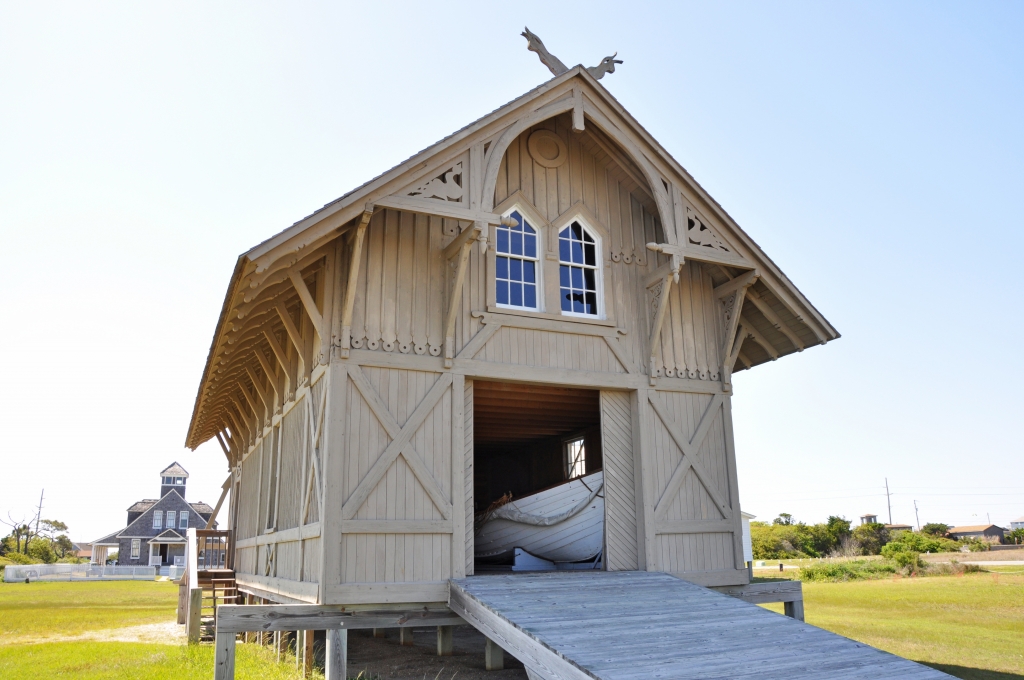
In 1959, the 1874 station was moved closer to the 1911 Station
by the National Park Service. The restored Beebe-McLellan
Self-Bailing Surfboat No.1046 that was used in the Mirlo rescue
was stored in the building by the NPS. The boat was restored and
displayed at the opening of Dulles Airport, then returned a few
years later.
In 1968, the buildings were bought from GSA by the Civic
Association for $500.00 and given to the Chicamacomico
Historical Association, Inc. The land was returned to the heirs
of D.O. Midgett and was later auctioned. After much bidding the
property was purchased by Mr. and Mrs. Walter Davis and given to
the Chicamacomico Historical Association. During this period a
problem developed as to the legal ownership of the original 1874
station. This was finally resolved and was the last building to
be deeded to CHA in 2002.
Restoration work continues on the seven buildings of the
Chicamacomico Life-Saving Station historic site. The 1911
Station is complete; the 1874 Station has been stabilized but
much work remains. Most of the out-buildings (two cookhouses,
stable, tractor shed, water tanks, etc.) are stabilized but not
restored.
The 1874 station is now open and is home to Surfboat #1046, a
Life Car developed for the Life-Saving Service of which only a
few remain in existence, a Beach Drill Cart and rescue
equipment, a Lyle gun, and other items.
The 1911 Station has displays, artifacts, photographs, exhibits
and video presentations for the public to view. During the
summer months, programs, book signings, open house events,
and other special events are offered. The 1st Thursday of
August is "Americans Heroes Day." Outreach
programs are available for surrounding areas. The Association’s
mission to educate the public about the important role the U.S.
Life-Saving Service played in North Carolina is foremost in its
plans.
The Beach Apparatus Drill reenactment had been performed at this
site for sixteen years by the NPS until 1994, when the
Chicamacomico Historical Association took over. After a brief
suspension of the drill (2002 - 2004), we are very pleased to
announce that the drill is back! Chicamacomico is the only place in the
nation to perform the complete drill
on a regular basis, and the
only place on the planet where it is performed by teams of
active-duty U.S. Coast Guard.
|